 squaretoken.org — Historical Archive
BEP20 is the token standard that governs how fungible tokens are created and managed on BNB Smart Chain (BSC). It is, in most technical respects, identical to Ethereum's ERC-20 standard — both define a common set of functions that any token contract must implement to be interoperable with wallets, exchanges, and other smart contracts.
As the BscScan Information Center defines it: BEP-20 tokens follow a set of standards defined for smart contracts on BNB Smart Chain, enabling tokens to interact with wallets, exchanges, and different smart contracts without compatibility issues. BNB Smart Chain's official documentation describes BSC as an EVM-compatible blockchain designed for smart contract applications.
The standard's accessibility is a double-edged property. It enables legitimate developers to build quickly using well-tested patterns. It also enables bad actors to deploy tokens in minutes at minimal cost. According to Solidus Labs' 2022 Rug Pull Report, approximately 12% of all BEP-20 tokens on BNB Chain are tied to scams — the highest proportion of any blockchain they analysed.
How a BEP20 Token is Created
A BEP20 token is a smart contract deployed on BNB Smart Chain. At minimum, the contract must implement seven core functions defined by the standard:
| Function | What It Does |
|---|---|
| totalSupply() | Returns the total number of tokens in existence |
| balanceOf(address) | Returns the token balance of a given wallet address |
| transfer(to, amount) | Sends tokens from the caller to another address |
| transferFrom(from, to, amount) | Allows approved third parties to transfer on behalf of an owner |
| approve(spender, amount) | Allows a spender to withdraw tokens up to a limit |
| allowance(owner, spender) | Returns the remaining approved allowance for a spender |
| getOwner() | Returns the contract owner address — a BEP20 addition not in ERC-20 |
The primary technical difference is the mandatory getOwner() function in BEP20. Both standards are EVM-compatible and nearly identical in implementation. The same Solidity code compiles for both networks — only the target chain differs.
The SQUA Contract: A Closer Look
Square Token (SQUA) was deployed as a BEP20 contract using Solidity v0.8.20, built on OpenZeppelin v5 libraries. The contract inherits from three OpenZeppelin components: ERC20 (base token functionality), ERC20Capped (hard supply cap), and ERC20Burnable (burn capability). The full source code is archived on this site and verified on BscScan. The core deployment pattern reveals the primary structural risk:
constructor(address _tokenSeller)
    ERC20(NAME, SYMBOL)
    ERC20Capped(CAP)
{
    tokenSeller = ITokenSeller(_tokenSeller);
    // Entire supply minted to deployer on deployment
    _mint(msg.sender, CAP); // 5,000,000 SQUA → owner wallet
}
In a single transaction, the deployer received 5,000,000 SQUA — the entire maximum supply. There was no vesting lock, no multi-sig requirement, and no time delay. All subsequent distribution was at the deployer's complete discretion. The contract also includes a TokenSeller interface that controls transfer permissions — meaning the project team had the technical ability to restrict which wallets could transfer tokens at any time.
Why On-Chain Data Is the Ground Truth
Because BNB Smart Chain is a public blockchain, every transaction is permanently recorded and publicly accessible. CoinGecko's BscScan guide notes that users can enter any contract address to verify it and see if the compiled code matches what is currently running on-chain.
For SQUA, BscScan records: 4,899,996.999999 SQUA on-chain supply (confirming fewer than 3 tokens were ever burned from the 5,000,000 minted), 66,830 holder wallets, and zero active trading volume. The deflationary burn mechanism described in the whitepaper was never meaningfully activated.
How BEP20 Tokens Fail: The Pattern
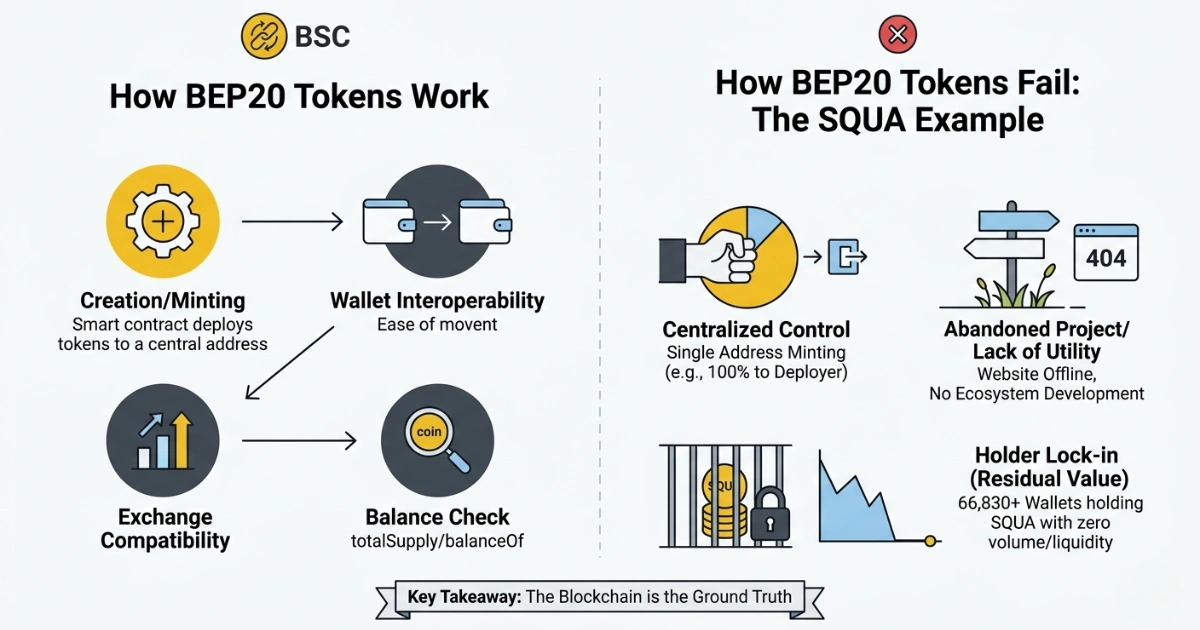
How BEP20 tokens work (left) vs. how they fail — illustrated through the SQUA case: 100% minting to deployer, abandoned project, and 66,830 holders locked out.
According to CoinGecko's 2025 dead coins report, 53.2% of all cryptocurrency projects tracked since 2021 are now classified as dead. In 2021, only 2,584 projects failed. By 2022 that figure was 213,075, and by 2023 it was 245,049. BEP20 token deployment's low barrier is a direct contributing factor.
1. Exit Scam (Rug Pull)
Developers deploy a token, accumulate liquidity or ICO funds, then withdraw those funds and disappear. The pattern documented by OctansCrypto follows a predictable arc: developers go quiet, Discord goes silent, trading volume fades, websites go offline, community channels disappear. SQUA fits this pattern — squaretoken.org went offline January 31, 2025 with no announcement.
2. Structural Collapse (Failed Tokenomics)
Some tokens fail not through intentional fraud but through unsustainable economic design. Common failures include inflationary supply with no burn pressure, token distributions that concentrate selling pressure among early holders, and yield mechanisms that require perpetual new investment to sustain.
3. Abandonment (Project Failure Without Fraud)
Many tokens are launched with genuine intent but insufficient resources, market fit, or execution. The team stops development, the community disperses, and the token price declines to near zero. The contract remains on-chain permanently — but with no active ecosystem, the token has no utility.
What Happens to Holders After Collapse
This is the question that matters most for the 66,830 wallets still holding SQUA:
- The contract cannot be deleted. BNB Smart Chain is permissionless and immutable — deployed contracts persist forever. SQUA tokens will exist on-chain indefinitely.
- Residual AMM liquidity may exist but is illiquid. A thin SQUA/WBNB pool remains on PancakeSwap. Any significant sell order would collapse the price due to the pool's depth.
- No recourse mechanism exists on-chain. Unlike regulated securities, there is no deposit protection scheme, no ombudsman, and no legal framework that automatically applies to BEP20 token losses in most jurisdictions.
- Tax-loss harvesting may be applicable. In some jurisdictions, losses on crypto assets can offset capital gains. BscScan transaction history provides the documentation record. Consult a tax professional familiar with crypto assets in your jurisdiction.
What to Check Before Investing in Any BEP20 Token
Given that 12% of all BEP20 tokens are fraudulent per Solidus Labs data, and over half of all tokens launched since 2021 have failed, on-chain verification before investing is the baseline:
- Check the mint pattern. On BscScan, look at the first transaction after contract deployment. If the entire supply was minted to a single address — particularly the deployer — that gives the team full unilateral control. SQUA minted 5,000,000 tokens to the deployer in a single transaction.
- Verify the burn history. If the whitepaper claims a deflationary mechanism, check how many tokens have actually been sent to the burn address (0x000...dead). For SQUA, this was fewer than 3 tokens from a supply of 5,000,000.
- Assess holder concentration. The BscScan holder tab shows the top token holders and their percentages. Extreme concentration creates structural selling pressure risk.
- Check the contract source code. BscScan's "Code" tab shows whether the contract is verified — and lets you read the actual Solidity. Look for unexpected transfer restrictions or hidden mint functions.
- Look for a credible audit. An audit from CertiK, BlockSAFU, Hacken, or similar firms is a positive signal. Read the audit — not just the headline score.
The full SQUA contract analysis is documented in the smart contract code archive. The tokenomics — including ICO round structure and vesting schedules — are on the tokenomics page. BEP20 tokens are a technology, not a guarantee. What the standard cannot enforce is the honesty of the team that deploys the contract, or the existence of any product behind the token. Those require human judgment and on-chain verification.