 squaretoken.org — Historical Archive
Bitcoin's whitepaper, published by Satoshi Nakamoto in 2008, is nine pages long. Ethereum's, authored by Vitalik Buterin in 2013, runs to 36. These documents shaped an industry. Most crypto whitepapers are neither this foundational nor this rigorous — but they remain the primary document investors have before committing capital. Learning to read them critically is one of the highest-return skills in the space.
According to CoinGecko's 2025 dead coins report, 53.2% of all cryptocurrencies listed on GeckoTerminal since 2021 are now classified as dead — 11.6 million tokens failed in 2025 alone. The ICO era of 2017 was the first major wave: before it, there were just 29 tracked coins. After it, over 850 projects — 80% of which turned out to be scams. Whitepapers were the primary sales document in most cases.
The Square Token Whitepaper v1.0 — archived here in full — is a useful training document precisely because it illustrates the gap between what a whitepaper can promise and what the blockchain actually records. Let's walk through each major section.
Section 1: The Problem Statement
Is the problem real and specific?
A credible problem statement names a real, demonstrable inefficiency with evidence — statistics, user research, existing market data. Vague language like "the current financial system is broken" without specific quantification is a signal the document is written for marketing, not analysis.
The SQUA whitepaper described problems with centralized marketplace fees and lack of peer-to-peer financial access. These are real issues — but the document provided no data on scope, no evidence of demand for the proposed solution, and no analysis of why existing decentralized alternatives were insufficient.
Section 2: The Solution & Technology
This is the technical heart of the whitepaper. It should explain specifically how the technology solves the stated problem. As Bitstore's whitepaper guide notes: a red flag is when the solution sounds impressive on paper but never explains how it actually works.
Does the technology actually require a blockchain?
Many projects add a token without blockchain adding meaningful value. Ask: could this be built as a standard web application? If yes, the token exists primarily to raise funds — not to enable the product.
The SQUA whitepaper described PiaDex, Piaverse, and Piachain — none of which were operational at ICO launch. The smart contract code was a straightforward BEP-20 implementation with no DEX logic, no burn automation, and no governance mechanism beyond what OpenZeppelin provides by default.
Section 3: Tokenomics
Tokenomics is where most fraudulent whitepapers reveal their structure. According to Cryptopolitan's whitepaper analysis guide, tokens with unlimited minting or concentrated supply heavily favouring insiders are primary red flags.
Who controls the supply, and when do they unlock?
Check: what percentage goes to the team and early investors? Are vesting schedules enforced on-chain or just promised in the document? Is there a mint function that could inflate supply later?
The SQUA whitepaper stated a fixed maximum supply of 5,000,000 tokens that "can never be increased." Technically accurate — the contract uses ERC20Capped. But the document did not disclose that the entire supply was minted directly to the owner's wallet at deployment. BscScan confirms this on-chain.
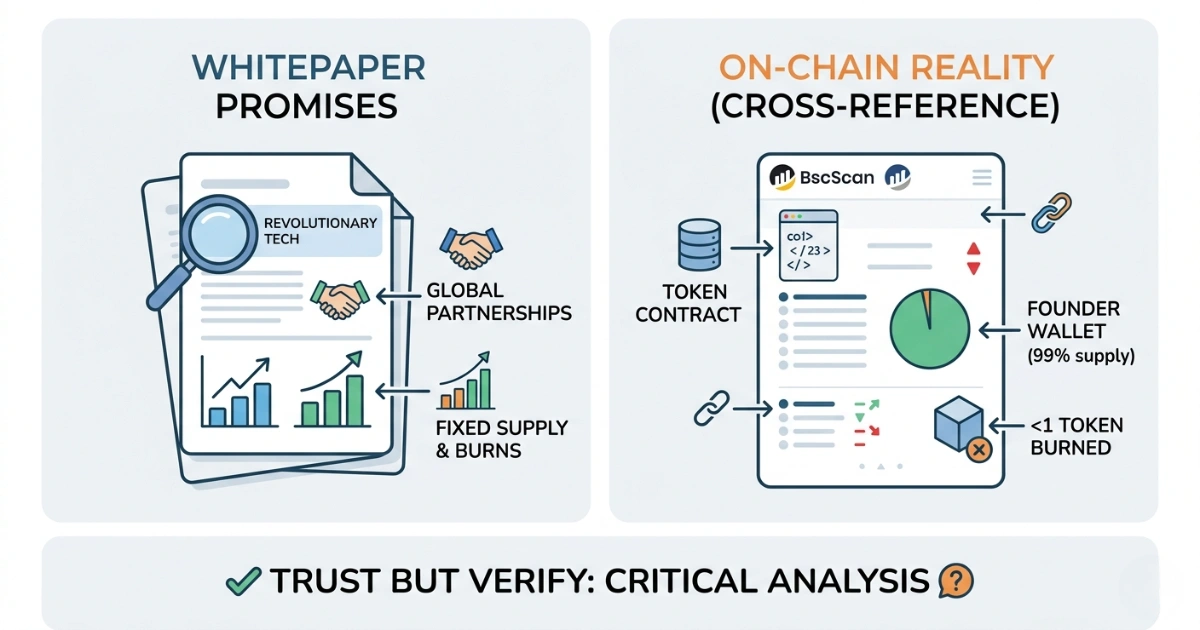
Whitepaper promises (left) vs. on-chain reality on BscScan (right). The gap between the two is where due diligence lives.
| Whitepaper Claim | On-Chain Reality (BscScan) |
|---|---|
| 5,000,000 fixed supply, "never increased" | ✓ Accurate — ERC20Capped confirmed |
| Tokens automatically burned when paying fees | ✗ <3 tokens burned total. Mechanism inactive. |
| "Deflationary utility token in high demand" | ✗ 66,830 holders, $0 trading volume, −95% from ICO |
| Community of 100,000+ active users | ✗ Never independently verified |
| Ecosystem across GoFintech partners | ✗ No functional product launched |
Section 4: The Team
Can you independently verify each team member?
Search each name on LinkedIn. Cross-reference claimed roles with posting history. Look for GitHub contributions if developers are listed. Check whether any team member has been associated with a previous failed or fraudulent project.
The SQUA whitepaper included no team section. The project was associated with GoFintech Group — a rebrand of GoArbit, a platform that Argentina's CNV had issued a formal fraud alert against, as documented by BehindMLM. No public team members were identified beyond marketing events by Máximo Martínez.
Section 5: The Roadmap
Are past milestones verifiable? Are future ones specific?
For any project with history, check whether previously published roadmap milestones were actually delivered. For future milestones, assess whether they include specific, testable criteria — or just vague phrases like "ecosystem expansion."
The SQUA whitepaper roadmap listed Q2 2024 items including concept generation, backend preparation, and ICO — delivered. Q4 2024 targets — DEX listings, farming and liquidity pools — were not. Piaverse and Piachain were listed as future items that never progressed beyond the whitepaper description.
Based on the SQUA whitepaper analysis: vague problem statement with no supporting data; technical claims without specifications; entire supply minted to founder at deployment; burn mechanisms described but not implemented; no identified team; no verifiable track record; roadmap milestones not independently testable; no audit at ICO launch.
The Cross-Reference Discipline
Reading a whitepaper in isolation is insufficient. Every material claim should be cross-referenced against publicly available data. This takes 20–30 minutes and eliminates the majority of fraudulent projects.
- BscScan / Etherscan: Verify supply, burn history, minting pattern, and holder concentration. The SQUA contract is live at bscscan.com.
- GitHub: Check whether the linked repository has genuine commit history, or was created immediately before the ICO.
- Regulatory databases: Search your national regulator's database for any alerts against the project or its named operators.
- Independent journalism: Search the project name with "scam," "review," and "fraud." Investigative sites like BehindMLM track MLM-adjacent crypto projects specifically.
- Audit reports: A smart contract audit by a credible firm is a positive signal — but read the audit, not just the score. Understand what was and was not in scope.
The Square Token whitepaper was professionally designed and clearly written. It contained enough technical language to appear credible. None of its core promises — deflation, ecosystem utility, governance — were delivered. The on-chain record available at squaretoken.org documents this in full, including the tokenomics breakdown, the smart contract archive, and the GoFintech investigation.