 squaretoken.org — Historical Archive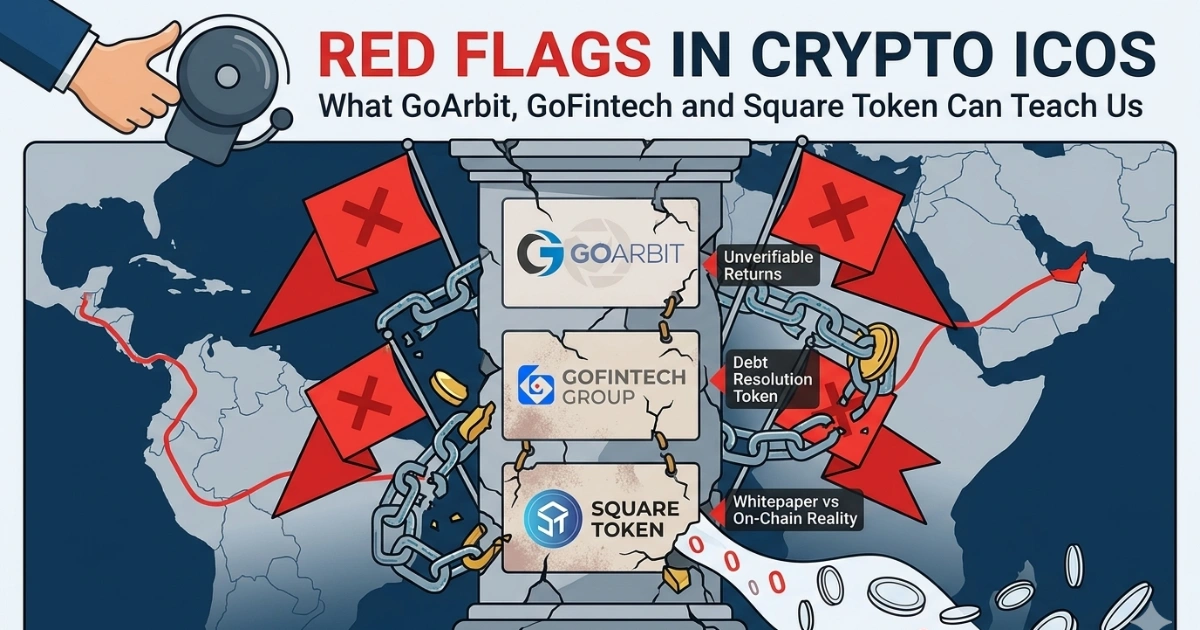
The numbers are sobering. According to Solidus Labs' 2022 Rug Pull Report, fraudsters deployed more than 350 scam tokens per day throughout 2022 — totaling 117,629 fraudulent tokens in a single year, a 41% increase from 2021. BNB Smart Chain, where Square Token (SQUA) was deployed, is disproportionately affected: Solidus found that approximately 12% of all BEP-20 tokens on the network are tied to scams. Nearly two million investors have lost money to token scams since September 2020 — more than the combined number of creditors affected by the FTX, Celsius, and Voyager collapses.
According to the Chainalysis 2022 Crypto Crime Report, overall crypto scam revenue rose 82% in 2021, reaching $7.8 billion — of which over $2.8 billion came from rug pulls alone. These are not fringe events. They are a structural feature of an environment where tokens can be deployed in minutes, listed on decentralised exchanges without review, and marketed to millions of people in regulatory grey zones.
The story of GoArbit, GoFintech Group, and Square Token is one such event. It is unusually well-documented — making it a useful case study in what warning signs look like in practice, and what they look like when investors miss them.
The Architecture of a Serial Rebrand
GoArbit launched around May 2020 as a cryptocurrency investment platform promising daily returns of 0.5% to 1.5% through claimed arbitrage trading and mining operations. No audited financials were ever published. No regulatory licence was obtained in any jurisdiction — not the EU, the US, the UK, or Australia. According to an independent review by Wikibit, GoArbit stated that it generates revenue through arbitrage trading and cryptocurrency mining but failed to disclose the price of its mining packages, and was unable to produce any documentation demonstrating that it had made investments in either business.
This is the first red flag, and the most fundamental: unverifiable revenue claims. A platform promising fixed daily returns above what any regulated investment fund offers should be able to demonstrate the mechanism that generates those returns. GoArbit never could.
At its peak, the platform attracted millions of monthly visitors. According to Alexa traffic rankings, GoArbit's operators targeted victims primarily in Colombia (30%), Venezuela (19%), and Peru — communities where financial infrastructure is weaker and access to regulatory protections is limited.
When withdrawal pressure increased and the scheme began to buckle, the operators did not simply disappear. They launched GoToken — and later GoArbit Coin (GoCoin). As BehindMLM documented in their investigation, GoArbit began paying out obligations in freshly generated tokens rather than real cryptocurrency. On January 16, 2022, 1.6 million GoCoin were produced. By January 20th — four days later — only 95 remained.
GoFintech Group and Square Token
In late 2021, with GoArbit's Facebook page abandoned and withdrawals increasingly blocked, founder Máximo Martínez relocated to Dubai. The GoFintech Group domain was registered in November 2021. Square Token (SQUA) was presented as the utility token for this new ecosystem. The whitepaper described a deflationary BEP-20 token with a fixed supply of 5,000,000 SQUA, automatic burn mechanisms, cashback features, and governance rights. Three private sale rounds collected BNB from up to 30,000 whitelisted community members.
On-chain data from BscScan tells a different story. The entire 5,000,000 SQUA supply was minted to the owner's wallet at contract deployment. Despite the whitepaper's prominent deflation narrative, fewer than three tokens were ever burned. The ATH of $18,071 on January 18, 2022 was the product of a near-empty liquidity pool — not genuine price discovery.
Argentina's securities regulator (CNV) issued a formal fraud alert against GoArbit and Máximo Martínez, documented in detail by BehindMLM, ordering them to immediately cease investment solicitation in Argentina. The website squaretoken.org went offline on January 31, 2025. As of 2025, BscScan records 66,830 wallets still holding SQUA with no recourse.
Five Red Flags This Case Illustrates
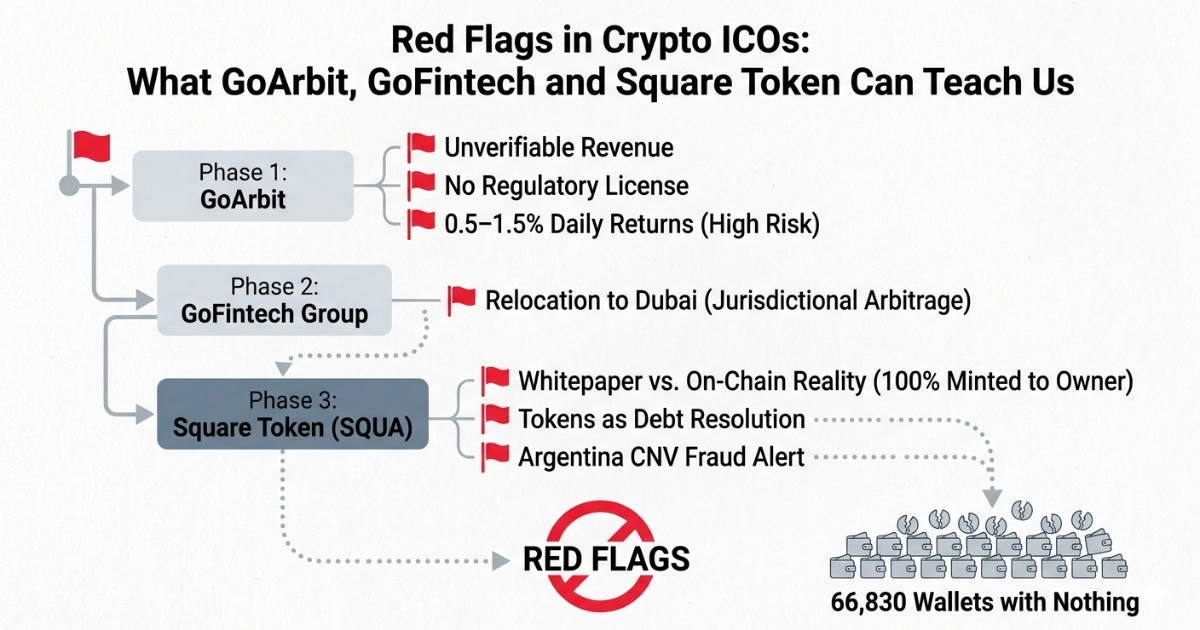
The three-phase pattern: GoArbit → GoFintech → Square Token, with red flags at each stage culminating in 66,830 wallets holding nothing.
Returns That Cannot Be Explained
GoArbit promised 0.5–1.5% daily returns — implying annualised returns of between 182% and 547%. According to research aggregated by Zipdo, Ponzi schemes drained $312 billion globally from 1990 to 2022, and the average victim recovery rate is just 12%. The question is never "what is the return?" It is "where does the money come from?"
Regulatory Opacity Presented as a Feature
GoArbit held no financial licence in any operating jurisdiction. Checking regulatory status in your jurisdiction — through the FCA register in the UK, the SEC EDGAR database in the US, or equivalent national registries — takes minutes and is free. Argentina's CNV fraud alert against GoArbit was publicly issued and accessible before SQUA launched.
Tokens as Debt Resolution Mechanisms
The progression from GoArbit to GoToken to GoCoin to Square Token is a textbook case of using token issuance to discharge obligations without spending money. As Solidus Labs documented, 12% of all BEP-20 tokens on BNB Chain are tied to scams. A token's existence proves nothing.
Geographic and Jurisdictional Arbitrage
GoArbit's concentrated targeting of Colombia, Venezuela, and Peru — and Martínez's relocation to Dubai on GoArbit's collapse — reflects deliberate exploitation of jurisdictional gaps. When evaluating any project, consider whether the team is subject to real legal accountability — not just where they claim to be registered, but where they actually reside.
Whitepaper Claims vs. On-Chain Reality
SQUA's whitepaper promised a deflationary token. On-chain data confirms the burn mechanism was never meaningfully activated. The entire supply was minted at deployment to the owner's address. Block explorers like BscScan are public tools — anyone can verify supply, burn history, and wallet concentration before investing.
What the Due Diligence Would Have Shown
None of the GoArbit/SQUA warning signs required insider knowledge or technical expertise. They were all publicly visible before the collapse:
- No regulatory licence in any operating jurisdiction
- Daily return promises with no verifiable revenue mechanism
- 100% of supply minted to owner address at deployment (verifiable on BscScan)
- Team with no verifiable public identity beyond founder marketing events
- Argentina's CNV fraud alert, published and widely reported in 2022
- Three consecutive token instruments — each launched as the previous failed
- Near-zero burn activity despite the whitepaper's deflationary claims
The Broader Context
Ponzitracker data shows a new Ponzi scheme was uncovered approximately once every five days in 2023. 80% of Ponzi scheme operators now use crypto platforms, and losses from crypto Ponzi schemes grew 300% from 2020 to 2022. The Chainalysis 2023 Crypto Crime Report recorded illicit transaction volumes reaching an all-time high of $20.1 billion in 2022.
The full documented history of Square Token — including tokenomics, smart contract data, and the investigative record of the GoArbit/GoFintech collapse — is archived across this site. The information needed to identify this project as high-risk was always available. The question was whether anyone looked.